Quick Answer: If a pipe is leaking under your sink, turn off the water supply valves beneath the sink immediately (clockwise to close). Place a bucket or towel under the leak. Then identify whether the leak is coming from the supply lines, the drain connections, the faucet body, or the garbage disposal. Supply line leaks need a plumber. Drain connection leaks are often a tightened slip nut or replaced washer. If you cannot identify the source or stop the flow, call a licensed plumber right away.
A puddle inside your sink cabinet is never something you can ignore until the weekend. Water pooling under a sink damages the cabinet floor, the subfloor beneath it, and the drywall behind it. Within 48 hours, saturated wood and drywall begin growing mold that can spread behind walls and into adjacent rooms. The good news is that most under-sink leaks are caused by a handful of common failures, and the first two steps are always the same regardless of the cause: stop the water and identify the source.
Step 1: Shut Off the Water
Look beneath the sink for two small valves on the wall — one for hot, one for cold. Turn both clockwise until they stop. If the leak stops, you know the failure is on the supply side (the pressurized lines that bring water to the faucet). If the leak continues only when you run the faucet or drain the sink, the failure is on the drain side.
If the shutoff valves are corroded, stuck, or break when you try to turn them (this happens frequently on older valves), shut off the main water supply to the house. Our Springtown home plumbing guide covers how to locate and operate your main shutoff.
Step 2: Identify Where the Leak Is Coming From
Dry everything under the sink with towels, then lay down dry paper towels or newspaper. Run the water for 30 seconds and watch exactly where moisture appears first. This narrows the leak source to one of four common locations.
Supply Line Connections: The braided or chrome supply lines that run from the shutoff valves to the underside of the faucet can develop leaks at either connection point. Over time, rubber washers inside the compression fittings harden, shrink, or crack, allowing water to seep past. Tightening the nut an additional quarter turn sometimes stops the drip. If the supply line itself is corroded, kinked, or swollen, replacement is the fix.
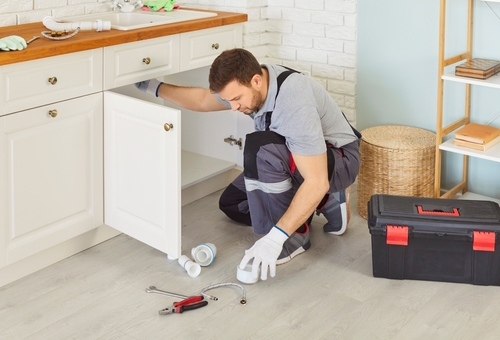
Drain P-Trap and Slip Nut Connections: The curved P-trap beneath the sink is held together by slip nuts and nylon or rubber washers. These connections loosen over time from vibration, temperature changes, or accidental bumps from items stored under the sink. If water drips from a slip nut while the sink is draining, hand-tighten the nut first. If that does not stop it, disassemble the connection, inspect the washer, and replace it if it is cracked or deformed.
Faucet Body or Base: If water seeps from around the base of the faucet and drips down the backside of the sink bowl into the cabinet, the faucet’s internal cartridge or O-ring seals have failed. This requires removing the faucet handle, replacing the cartridge or O-rings, and reassembling. On older faucets, full fixture replacement is often more cost-effective than rebuilding worn components.
Garbage Disposal or Dishwasher Connection: If your kitchen sink has a garbage disposal, check the mounting ring where the disposal meets the sink drain (held by a snap ring and putty seal) and the dishwasher drain hose connection on the side of the unit. Both are common leak points that worsen over time.
When It Is Beyond a DIY Fix
If the leak is coming from inside the wall behind the sink, from a corroded pipe that crumbles when you touch it, or from a fitting that requires soldering or specialized tools, a licensed plumber needs to handle the repair. Attempting to tighten corroded galvanized fittings often snaps the pipe, turning a drip into a flood.
If you are noticing leaks at multiple fixtures simultaneously, or if your water bill has been climbing alongside the visible leak, the problem may be systemic rather than isolated to one sink.
Preventing Future Under-Sink Leaks
Check under every sink in your home quarterly. Look for moisture, discoloration on the cabinet floor, or a musty smell. Replace braided supply lines every 8 to 10 years as preventive maintenance, even if they look fine externally — the internal rubber lining deteriorates with age and can fail suddenly.
For homes in Millsap and other areas on well water, mineral deposits accelerate fitting corrosion and washer failure. More frequent inspection intervals of every three months are appropriate.
SNP Plumbing handles residential plumbing repair across Springtown, Weatherford, Azle, Boyd, Newark, and all of Parker County. Contact us for same-day leak repair before cabinet and floor damage escalates.
FAQ
Q: Can a leaking pipe under my sink cause mold? A: Yes. Mold can begin growing on wet wood and drywall within 24 to 48 hours. The dark, enclosed space under a sink cabinet is an ideal mold environment. If you discover a leak that has clearly been dripping for days or weeks based on water damage and musty odor, have the affected area inspected for mold in addition to repairing the leak.
Q: How much does it cost to fix a leaking pipe under a sink? A: Simple repairs like replacing a supply line or tightening a slip nut typically cost $75 to $200 with a service call. If the leak involves corroded pipe in the wall, a failed faucet requiring replacement, or water damage remediation, costs can range from $250 to $800 or more depending on scope.
Q: Should I use plumber’s tape or pipe dope to stop a leak under my sink? A: Teflon tape (plumber’s tape) works only on threaded connections and only if the threads are in good condition. If the leak is at a compression fitting or slip nut, tape will not help. Never apply tape as a patch over a crack or hole in a pipe — it is not designed for that purpose and will fail immediately under pressure.
Q: Why does my pipe leak under the sink only when I run the dishwasher? A: The dishwasher drain hose connects to either the garbage disposal or a dedicated dishwasher tailpiece on the drain. If that connection is loose, cracked, or the hose clamp has failed, water only leaks when the dishwasher pumps water through that specific path. Check the hose clamp and the connection point for visible gaps or deterioration.