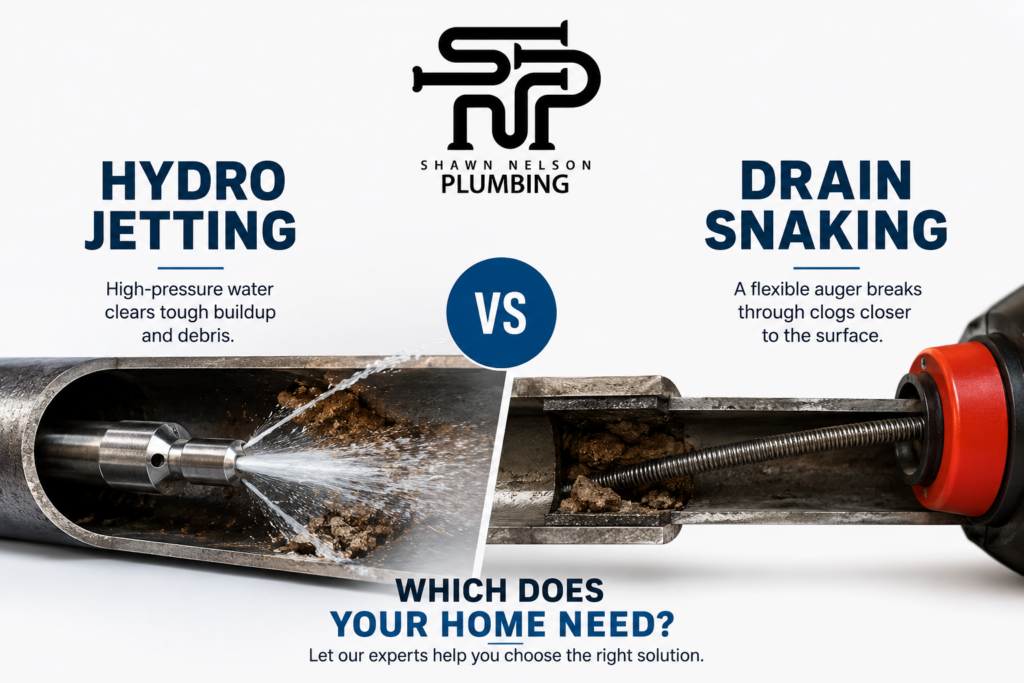
Drain snaking punches a hole through a clog, while hydro jetting scours the entire pipe clean with high-pressure water. For a one-off clog, snaking is often enough. For recurring backups, grease, or roots, hydro jetting is the lasting fix.
When a drain keeps backing up, the question is not just how to clear it once, but how to keep it clear. Two tools do most of this work, and they are not interchangeable. Knowing the difference helps you avoid paying for a quick fix when you need a real one, and it helps you understand what your plumber is recommending. Here is how snaking and hydro jetting compare for homes around Springtown and Parker County.
What drain snaking does
A drain snake, or auger, is a flexible cable fed down the line until it reaches the blockage. The tip breaks through the clog or hooks it so it can be pulled out. Snaking is fast, inexpensive, and effective for a single, localized clog like a hairball in a bathroom drain or a simple obstruction in a kitchen line. Its limitation is that it punches through the blockage rather than removing everything. The pipe walls stay coated, so if the underlying cause is grease buildup or root intrusion, the clog tends to return.
What hydro jetting does
Hydro jetting uses a specialized nozzle to blast water through the line at very high pressure, scouring the full interior of the pipe. Instead of poking a hole through a clog, it strips the buildup off the pipe walls entirely: grease, scale, sludge, and root matter. The result is a line that is not just open but actually clean, which is why the results last far longer. It is the right tool for recurring backups, grease-heavy kitchen lines, and lines with root intrusion, and it is often paired with a camera inspection so the plumber can confirm the line is clear and check for damage.
Which one is right for your situation
- A single slow or clogged drain that has not been a repeat problem usually only needs snaking.
- Recurring backups in the same line point to buildup that snaking will not solve. This is hydro jetting territory.
- Multiple drains backing up at once suggests a main line issue that often calls for jetting after a camera inspection.
- Grease-heavy kitchen lines respond far better to jetting, since grease re-coats a snaked line quickly.
- Older lines with root intrusion common on established Parker County properties benefit from jetting, though a badly damaged line may need repair instead.
A note on older and rural lines
Hydro jetting is powerful, and on a fragile, corroded, or already-cracked line it is not always the right call. A good plumber inspects the line first, often with a camera, before jetting an older pipe. If you are dealing with a line that keeps failing, see our sewer camera inspection service, which takes the guesswork out of what is actually happening inside the pipe.
Frequently asked questions
Is hydro jetting safe for my pipes?
For pipes in good condition, yes. On older, corroded, or already-damaged lines, a plumber should inspect with a camera first, since high pressure can worsen an already-failing pipe. That inspection is exactly why jetting and camera work often go together.
How often should I have my drains hydro jetted?
Most homes do not need it on a schedule. It is best used when buildup or recurring clogs call for it. Homes with grease-heavy use or a history of root intrusion may benefit from periodic jetting.
Why does my clog keep coming back after snaking?
Snaking clears a path through a clog but leaves the pipe walls coated. If the cause is grease or roots, the buildup re-forms quickly. Hydro jetting removes the buildup itself, which is why it lasts longer.
Recurring clogs in the Springtown area? Let us look.
If snaking keeps failing, the line is telling you something. SNP Plumbing can diagnose the real cause and recommend the right fix, not just the fast one.
Call now: (817) 487-8866