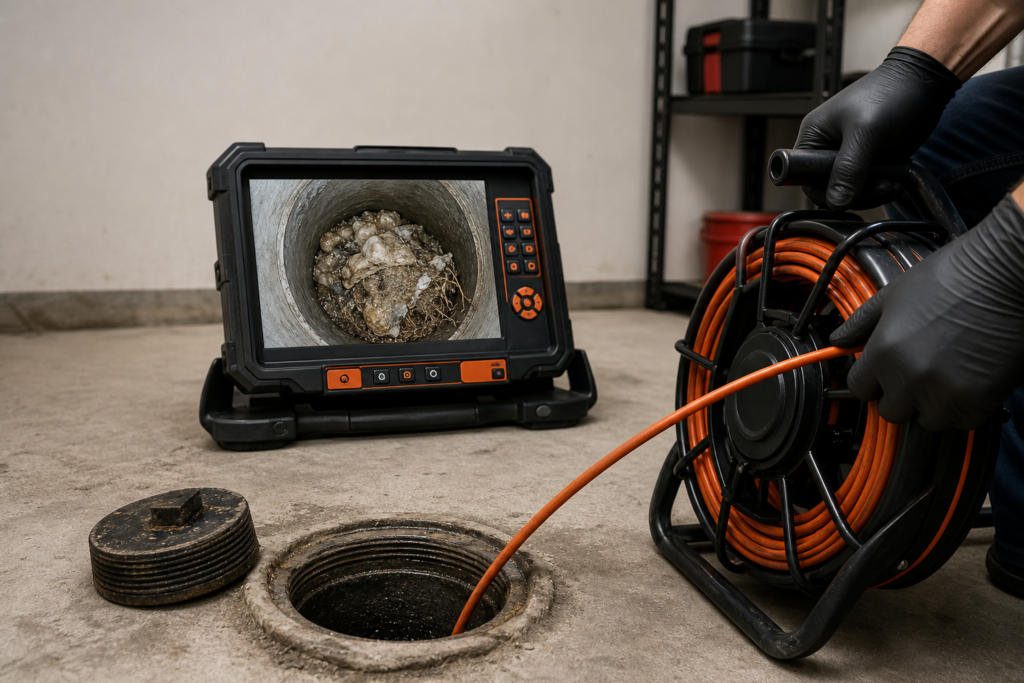
A sewer camera can show only the pipe surfaces reached by its lens and light. If wet paper, grease, roots, mud, or another dense obstruction fills the line, the camera may stop at the blockage or show only its front surface. The footage can confirm where the view became limited, but it may not reveal the pipe condition behind or beneath the material.
That limitation does not automatically mean the sewer line is collapsed or must be replaced. It means the plumber needs enough safe access and visibility to separate a removable obstruction from a damaged or misaligned pipe. Depending on the line’s condition and the symptoms in the home, restoring flow and making another camera pass may provide the missing evidence.
Seeing a Blockage Is Not the Same as Seeing the Whole Problem
A professional sewer camera has a small lens and built-in lights on the end of a flexible cable. The camera gives a direct view of the reachable pipe interior, but it cannot see through an opaque mass. A thick grease deposit, compressed paper, roots, settled mud, or a foreign object can cover the pipe wall and block the route ahead.
The first pass may show where the obstruction begins without showing:
- How far the material extends.
- Whether the pipe continues normally behind it.
- Whether roots entered through a separated joint or another opening.
- Whether a crack, offset, low spot, or collapse is hidden underneath.
- Whether more than one obstruction is present farther down the line.
The lens can also become coated while it moves through soft material. In that situation, the image may turn cloudy or dark even when the camera is still moving. Pulling the camera back and cleaning the lens can help, but it will not create a view through material that still fills the pipe.
What a Limited First Pass Can Still Establish
An incomplete sewer camera inspection can still provide useful information. The plumber can document the access point, the distance traveled, the surfaces visible before the obstruction, and the exact place where the camera stopped or the image became obscured.
Depending on conditions, the first pass may reveal:
- Grease, scale, roots, paper, or another visible material at the front of the restriction.
- An exposed crack, separated joint, or deformation before visibility is lost.
- Whether the camera can pass through a small remaining opening.
- A change in pipe material or diameter near the problem area.
- Standing water collecting behind the restriction.
- Whether the same point has stopped earlier cleaning or inspection equipment.
Distance markings on the cable help estimate where the problem sits along the route, but they do not automatically establish exact depth, surface location, or responsibility for that section of pipe. Bends, cable movement, cleanout position, and the actual pipe route all affect how the distance is interpreted.
Why Clearing the Line May Come Before a Second Camera Pass
When a blockage prevents the camera from reaching the suspected problem, the immediate goal may be to restore safe flow. Professional drain cleaning can remove or open some obstructions so the camera can travel farther and the pipe wall can be reviewed afterward.
The appropriate cleaning method depends on the obstruction and the line. A mechanical cable may be considered for certain clogs or roots. Water-based cleaning may be discussed for suitable pipe with heavy grease or soft buildup. A plumber should consider pipe material, age, condition, available access, and the risk of worsening an already damaged section before choosing equipment.
Clearing is not a substitute for diagnosis. It may expose the condition that caused the blockage to form or return. For example, the second pass may reveal roots entering at a joint, a rough corroded surface that collects debris, an offset connection, a low section that holds waste, or an intact pipe that was obstructed by a removable clog.
Cleaning also cannot correct every condition. It will not lift a settled pipe, reconnect a separated joint, or rebuild a collapsed wall. If equipment cannot pass safely, the plumber may need another access point or a different diagnostic approach instead of forcing the camera through.
What the Second Inspection Should Clarify
A useful second pass is meant to answer questions the obstruction hid. After flow is restored and the camera lens is clear, the plumber can compare the newly visible section with the first recording.
The follow-up footage may clarify:
- Whether the obstruction was fully removed or only opened enough for flow.
- Whether the pipe wall is intact behind the blockage.
- Whether roots, cracks, corrosion, or shifted joints contributed to the restriction.
- Whether water continues to stand at the same location after the line drains.
- Whether another blockage is present farther downstream.
- Whether the camera can reach the connection or endpoint needed for the evaluation.
Ask to see the footage and have the plumber identify the access point, travel direction, and location where visibility changed. A clear explanation should connect the observed condition to the recommended next step. If a structural concern appears after cleaning, the conversation may turn to sewer line repair or replacement, but the repair scope should match the evidence actually collected.
A Blocked View Does Not Prove a Broken Pipe
A camera stopping at one location does not by itself prove the pipe is collapsed. Dense roots, a lodged object, compacted waste, a sharp accessible bend, or a layer of buildup can all limit travel. Likewise, dark or cloudy footage may result from material on the lens rather than a failure of the pipe wall.
Camera footage alone cannot determine:
- The full condition of a surface hidden by the obstruction.
- The exact cause of every area of standing water.
- How much pipe remains affected beyond the camera’s reach.
- The remaining service life of the material.
- Whether cleaning, spot repair, or replacement is the right choice without the rest of the plumbing context.
- The safest excavation location or depth without confirming the pipe route.
Recurring symptoms matter. A blockage that returns soon after cleaning, affects several fixtures, or repeatedly forms at the same recorded location deserves closer investigation. The plumber should consider the backup pattern, cleaning history, pipe material, property layout, and both pre-cleaning and post-cleaning footage before recommending structural work.
When Reinspection Is Worth Discussing
Another camera pass is useful when conditions have changed enough to reveal new evidence. Reinspection may be worth discussing when:
- The first camera could not pass the obstruction.
- Waste or grease covered the lens and hid the pipe wall.
- The blockage was opened and the pipe beyond it has not yet been viewed.
- A repair decision depends on whether the newly exposed pipe is intact.
- Backups returned after an earlier cleaning.
- Earlier footage ended before reaching the suspected section.
Repeating the same pass without clearing the obstruction or changing the available access may produce the same limitation. Ask what will be different on the next attempt and what specific question the plumber expects it to answer.
What Springtown Homeowners Should Do Before the Appointment
Tell the plumber which fixtures are slow or backing up, when the problem started, and whether it happens after laundry, showers, or other heavy water use. Mention earlier drain cleaning, previous camera footage, outdoor wet areas, sewer odors, or repairs along the same route. These details help connect the camera image to the way the system is behaving.
If you know where the cleanout is, move small belongings away from the work area but leave the cap closed. Do not open a sewer cleanout yourself. Wastewater may be held behind the blockage and can escape under pressure when the cap is removed.
Avoid adding water to test a line that is already backing up. Limit fixture use if several drains are affected or wastewater is appearing at a low shower, tub, or floor drain. Tell the plumber if a chemical drain product has been used so the work can be approached safely.
Arrange a Sewer Camera Inspection in Springtown
If recurring backups or incomplete footage are leaving questions about your sewer line, contact SNP Plumbing. A plumber can evaluate the available access, explain what the first camera pass shows, and determine whether clearing, reinspection, or another diagnostic step fits the conditions found.
Related reading: For a homeowner walkthrough of the process, see our sewer camera inspection guide for Weatherford, TX homeowners.