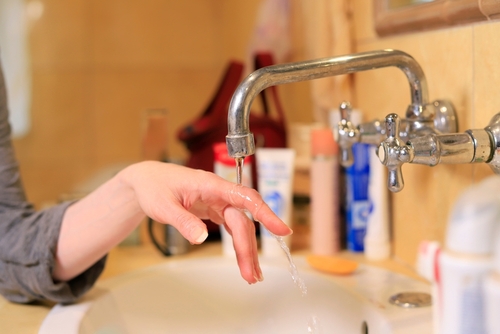
Quick Answer: Low water pressure throughout your house is usually caused by a failing pressure regulator, corroded galvanized pipes restricting flow, a partially closed main shutoff valve, or a hidden water leak. If only one faucet has low pressure, the problem is likely a clogged aerator or a local supply valve issue. Start by checking your shutoff valve and aerators before calling a plumber.
When you turn on the shower and get a weak trickle instead of a steady stream, it affects everything from rinsing shampoo to filling a pot for dinner. Low water pressure is one of the most common plumbing complaints in North Texas homes, and the fix depends entirely on whether the problem is affecting your whole house, one floor, or a single fixture. Each scenario points to a different cause, and understanding the difference saves you from paying for the wrong repair.
Whole-House Low Pressure: The Big Causes
If every faucet, shower, and appliance in your home has weak pressure, the problem is upstream of your individual fixtures, somewhere between the city main (or well pump) and the point where your supply lines branch to different rooms.
Failing Pressure Regulator: Most homes connected to a municipal water supply have a bell-shaped pressure reducing valve (PRV) installed where the main supply enters the house. This device reduces city supply pressure (which can be 80 to 150 PSI) down to a safe household range of 40 to 60 PSI. When the PRV fails, it typically fails in the closed direction, dramatically reducing pressure throughout the house. PRVs last 10 to 15 years on average. If your home is in that age range and pressure has gradually dropped, the PRV is the prime suspect.
Corroded Galvanized Pipes: Homes built before the mid-1990s throughout Springtown, Weatherford, Boyd, and other Parker County communities commonly have galvanized steel water supply lines. These pipes corrode from the inside out over 25 to 40 years, building up rust and mineral deposits that progressively narrow the interior diameter. A pipe that started at 3/4 inch can corrode down to an effective opening of 1/4 inch, strangling flow to your fixtures. The only permanent fix is water line replacement with modern copper or PEX.
Partially Closed Main Shutoff Valve: This sounds too simple, but it is one of the most common causes of sudden pressure loss. If any work was recently done on your plumbing, your water was turned off for any reason, or you have a gate valve that has not been exercised in years, it may not be fully open. Locate your main shutoff and verify it is turned completely counterclockwise (for gate valves) or fully in line with the pipe (for ball valves).
Hidden Water Leak: A significant leak in your main supply line bleeds pressure before water reaches your fixtures. If your pressure dropped suddenly rather than gradually, and your water bill has increased without explanation, a hidden leak is likely. Professional water leak detection locates the failure point without excavation. Our guide on locating water leaks underground covers the full detection process.
Low Pressure at One Faucet Only
If pressure is fine everywhere else but one fixture is weak, the cause is local to that fixture.
Clogged Aerator: The aerator is the small screen at the tip of your faucet spout. It traps sediment, mineral flakes, and debris that break loose from your pipes. In hard water areas like Parker County, aerators clog frequently. Unscrew it, clean the screen, and reinstall. If pressure returns to normal, that was the entire problem.
Local Supply Valve Not Fully Open: Every fixture has individual shutoff valves under the sink or behind the toilet. If one was bumped, partially closed during a repair, or has corroded into a partially closed position, it restricts flow to that fixture only.
Blocked Supply Line to Fixture: On older homes, the small-diameter supply lines running from the main branch to individual fixtures can develop mineral blockages or kinks, especially if they are original galvanized risers.
Low Pressure on Hot Water Only
If only your hot water side has weak pressure while cold runs fine, the problem is between your water heater and your fixtures. A water heater with heavy sediment buildup, a partially closed inlet valve on the heater, or corroded hot water supply pipes downstream of the heater all restrict hot-side pressure independently. If your hot water is also running out faster than normal, sediment in the tank is affecting both volume and flow.
When to Call a Plumber
If you have checked your shutoff valve, cleaned your aerators, and the problem persists, a licensed plumber needs to perform a pressure test at multiple points in your system to isolate the cause. Residential plumbing diagnostics from SNP Plumbing include pressure testing, pipe material assessment, and a clear recommendation for repair or replacement.
Contact SNP Plumbing to schedule a pressure diagnostic across Springtown, Weatherford, Azle, and Parker County.
The International Association of Plumbing and Mechanical Officials publishes residential plumbing standards that define acceptable pressure ranges for household fixtures.
FAQ
Q: What is normal water pressure for a house? A: Normal residential water pressure is between 40 and 60 PSI. Below 40 PSI you will notice weak flow at fixtures. Above 80 PSI puts stress on pipes, fittings, and appliances and can cause leaks. You can test your pressure with a $10 gauge that threads onto any outdoor hose bib.
Q: Can hard water cause low water pressure? A: Yes. Hard water deposits calcium and magnesium scale inside pipes over time, narrowing the interior diameter and restricting flow. This is especially common in Parker County homes on galvanized steel pipe. The scale buildup is permanent and cannot be flushed out. Pipe replacement is the only long-term solution.
Q: Why is my water pressure low in the morning only? A: Morning pressure drops are usually caused by peak demand on the municipal supply. If everyone in your neighborhood showers, runs dishwashers, and waters lawns at the same time, the city main experiences temporary pressure drops. If this is a daily pattern, a pressure booster pump can maintain consistent household pressure.
Q: Does a water softener reduce water pressure? A: A properly sized and maintained water softener should not noticeably reduce pressure. However, a unit that is undersized for your household, overdue for regeneration, or has a clogged resin bed can restrict flow. If pressure dropped after installing a softener, have the unit inspected for proper sizing and function.